How Do Solar Batteries Work to Cut Your Energy Bills?
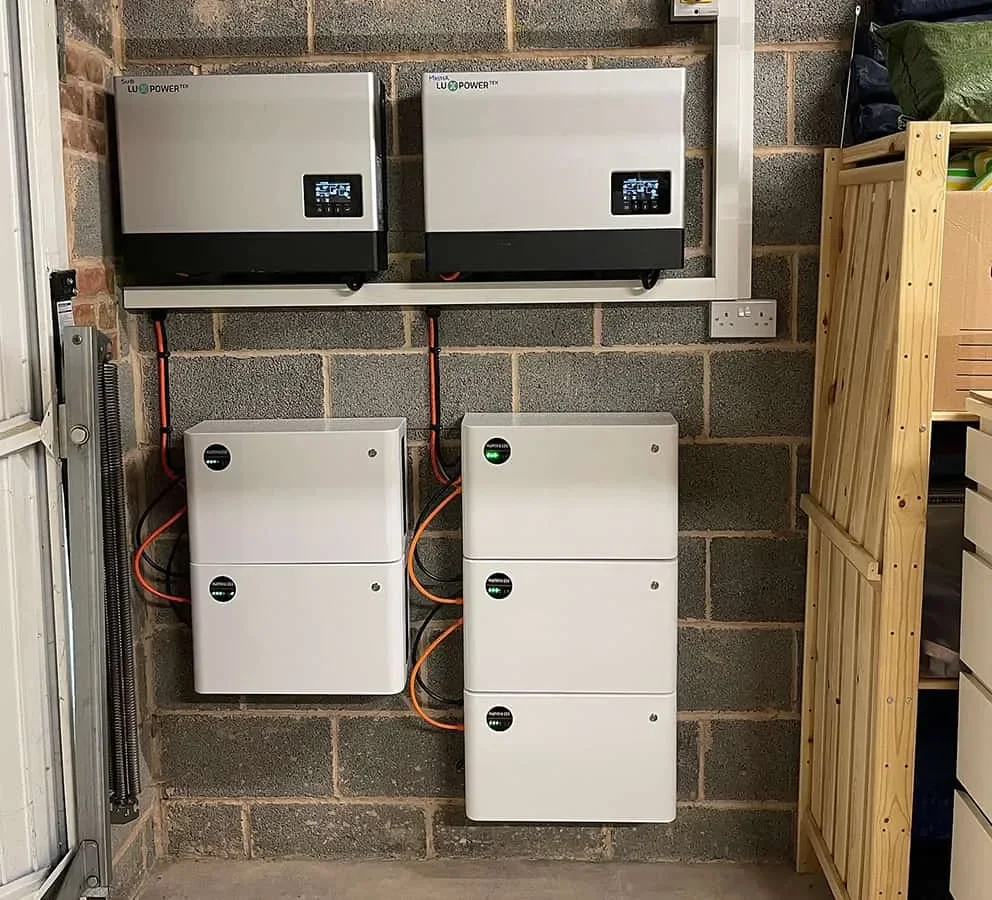
How do solar batteries work – and why are so many UK homeowners adding them to their solar panels?
In simple terms, your solar panels generate electricity, your home uses what it needs, and a battery stores the spare so you can use it later instead of buying from the grid. That means you rely less on expensive peak-time electricity, make better use of your own renewable energy, and can even keep key circuits running if there’s a power cut (depending on how the system is set up).
In this guide, we’ll break down how solar battery storage works step by step – from sunlight hitting your panels and creating DC electric current, through the inverter and battery charge cycle, to powering your home in the evening or during an outage. We’ll keep the tech clear and practical, drawing on P4 Solar’s experience designing and installing solar energy storage systems across the UK, so you can understand what’s happening behind the scenes and decide whether a battery is right for your home.
⚡ See What a Battery Could Save You
Wondering how much less you could be buying from the grid if you added storage? P4 Solar designs solar and battery systems around real usage data, so your setup works hard in the evenings, winters and price spikes that matter most.
💡 Get a free, no-obligation quote and personalised battery assessment.
How Does a Solar Battery Work?: Quick Breakdown
A solar battery takes the solar energy you don’t use straight away, stores it safely, and then feeds it back into your home later so you buy less from the grid – especially in the evening when electricity is most expensive.
Here’s how that looks in a typical UK solar power system:
1. Your panels generate DC power
Sunlight hits your photovoltaic system, and the panels produce direct current (DC) electric current whenever there’s daylight.
2. The inverter handles energy conversion
A (hybrid) inverter converts that DC into AC for your sockets and manages basic voltage regulation, making sure everything is at the right voltage and frequency for your home.
3. Your home takes priority
Your home uses the solar power first – lights, fridge, appliances. This reduces what you import from the grid in real time.
4. Spare energy goes into solar battery storage
When there’s more solar than your home needs, the extra is sent to the battery as part of a charge cycle. Inside the battery, clever battery chemistry converts electrical energy into stored chemical energy.
5. The battery steps in when solar drops
In the evening, at night, or on dull winter days, the battery discharges. DC power flows back out of the battery, through the inverter, is converted to AC again, and quietly runs your home instead of the grid.
6. Optional: power backup during cuts
If your system is designed for power backup, the battery can keep selected circuits running during an outage – typically lighting, Wi-Fi, and key sockets – turning your system into a small, silent backup generator.
From your side, all of this is automatic: the system constantly decides whether to power your home from the panels, charge the battery, draw from it, or fall back to the grid.
➡️ If you’re mainly wondering whether a battery will pay for itself, we’ve covered that in more detail here: Are solar batteries worth it?
Now, we’ll break down each part of this process in more detail, so you can really understand how solar battery storage works and what that means for your home day to day.
Inside a Solar Battery – The Science Made Simple
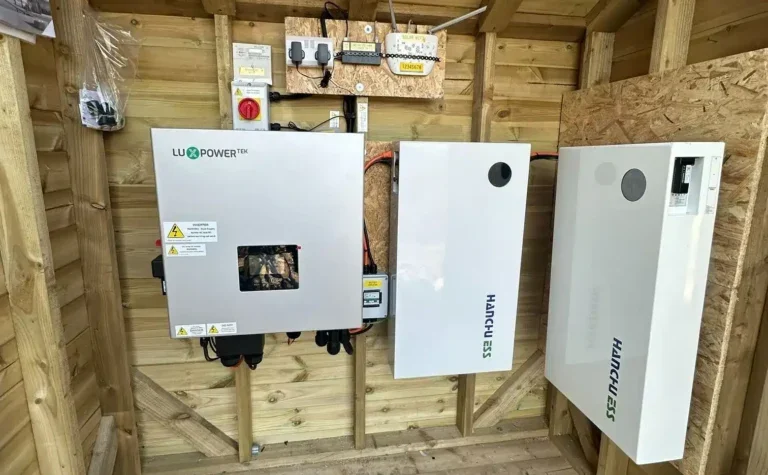
So far, we’ve looked at how a battery fits into your solar power system. But what’s actually happening inside the battery when it charges and discharges? Understanding this helps explain why some batteries last longer, why battery chemistry matters, and what a “charge cycle” really is.
Battery Chemistry
Most high-quality home solar batteries today use lithium-ion chemistry, especially the safer and longer-lasting LiFePO₄ (lithium iron phosphate). At P4 Solar, we install many LiFePO₄-based systems because they offer:
Excellent cycle life (thousands of charge cycles)
High energy density for compact storage
Stable performance in colder UK weather
Strong safety characteristics
Inside the battery are:
Cells: the core units storing energy
Electrodes: the positive (cathode) and negative (anode) sides
Electrolyte: which allows ion movement inside the cell
When your solar panels generate spare DC electric current, the battery begins storing it through a chemical process:
During charging: lithium ions move to the anode and stay there — this is stored chemical energy.
During discharging: ions flow back to the cathode, releasing electrical energy that powers your home.
This movement of ions is the heart of energy conversion inside every solar battery. It’s why battery chemistry plays such a big role in lifespan, efficiency, and long-term savings.
Charge Cycles
A charge cycle is one full round of using the battery’s capacity. But in real homes, this usually happens across lots of smaller movements — which matters because it affects long-term battery health.
Example:
Day 1: battery charges from 30% → 80% (50%)
Day 2: battery charges from 40% → 90% (50%)
Together = roughly one full cycle.
Over time, each battery is rated for a certain number of cycles before its capacity noticeably reduces.
From a savings point of view:
Deeper daily cycles (e.g. near-empty to near-full) extract more value per day but wear the battery faster.
Shallower cycles are gentler, keeping the battery healthier for longer but may leave some storage “unused”.
When we design a system at P4 Solar, we aim for the sweet spot:
A battery that cycles often enough to meaningfully reduce your grid imports
But not so aggressively that it burns through its cycle life too quickly
That balance is a big reason why two similar homes, with similar kit, can see very different results on payback.
The Battery Management System
Every modern home battery includes a Battery Management System (BMS). Think of it as a guardian for your storage and your savings.
The BMS constantly monitors:
Cell voltage and current
Temperature across the pack
Balance between individual cells
Its jobs include:
Preventing over-charging and over-discharging (which can permanently damage cells)
Managing voltage regulation in partnership with the inverter
Protecting the battery in very cold or hot conditions
Keeping cells balanced so the whole pack ages evenly
Why this matters for your bills:
A well-managed battery maintains higher usable capacity for longer, so it can keep covering your evening and night-time usage year after year.
Good BMS behaviour reduces the risk of premature failure – avoiding a very expensive early replacement.
When paired with a smart inverter and sensible settings, it helps maximise how much of your own solar you use, rather than exporting cheaply or buying back at higher rates.
At P4 Solar, we pay close attention to the installation environment (garage vs utility room vs outbuilding), cable runs and loading. That’s because the BMS can only do its job properly if the battery is installed within its designed temperature and electrical limits – which directly impacts both performance and long-term savings.
💡 Bringing It All Together
Battery chemistry determines how many years of daily charging and discharging you can expect.
Charge cycles and how you use the battery shape how quickly it degrades.
The BMS and inverter work together to keep everything safe, efficient, and within the sweet spot for long life.
The better all three are specified and installed, the more of your own renewable energy you’ll use – and the less you’ll spend on grid electricity over the lifetime of your system.
How Does Solar Battery Storage Work Day-to-Day?
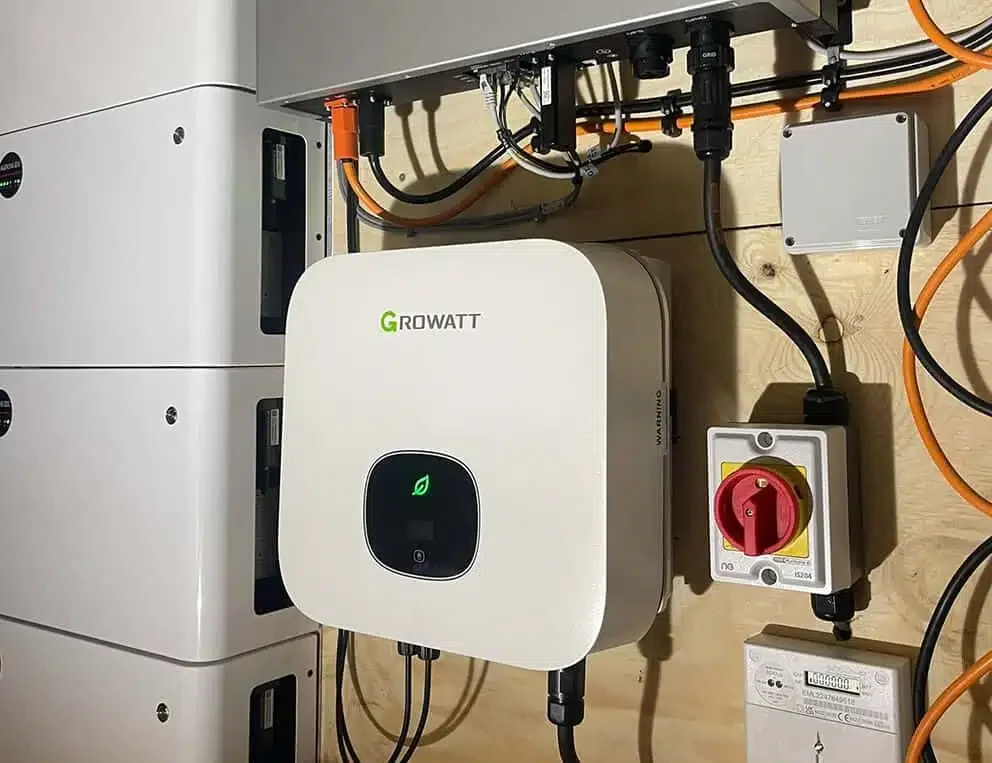
So far we’ve looked at the tech. Now let’s bring it back to what most UK homeowners really care about: how solar battery storage works in day-to-day life.
Using More of Your Own Solar First (Self-Consumption)
In a typical setup, your solar power system is always trying to do three things, in this order:
Power your home directly from your solar panels
Charge your solar battery
Export any genuine excess to the grid
During a sunny day:
Your photovoltaic system generates DC power.
The inverter converts it to AC and runs your appliances in real time.
Once your immediate usage is covered, surplus energy flows into the battery, starting a charge cycle.
➡️ Wondering what happens when it’s overcast? Check out our full guide covering how solar panels work on cloudy days.
Then later:
In the evening and overnight, when your panels aren’t generating, the battery discharges.
Stored energy is converted back to AC and runs your home instead of expensive peak-rate grid power.
This is the core of how solar batteries work to cut your bills: they shift your own cheap, daytime solar into the times you’d normally be paying the highest rates.
Working with Time-of-Use Tariffs and Smart Charging
Many modern systems also integrate with time-of-use tariffs – where electricity prices change through the day.
In that case, how do solar batteries work with tariffs?
On bright days, your solar charges the battery as normal.
On dull days or in winter, the battery can also charge from the grid when prices are low (usually overnight).
The stored energy is then used during peak-rate periods, when unit prices are significantly higher.
That means your battery becomes a small energy trading tool:
Charge when energy is cheap
Discharge when energy is expensive
From a savings point of view, that can make a well-sized battery pay for itself faster, especially in homes with regular evening usage.
At P4 Solar, we design systems to work intelligently with both your solar generation and your tariff, so you’re not relying on luck with the weather alone.
Power Backup When the Grid Goes Down
On their own, solar systems won’t work in a blackout – standard grid-tied systems shut down for safety. But with the right hardware, solar battery storage can provide power backup.
Here’s how it works in a backup-capable system:
If the grid fails, the inverter detects the outage and isolates your home from the grid.
The battery and inverter form a small, local power supply just for your property (or for selected “essential” circuits).
As long as there’s enough charge in the battery – and, in daytime, enough solar – those circuits keep running.
Most UK homes choose to back up essentials like:
Lighting in key rooms
Wi-Fi and router
Fridge/freezer
A few important sockets (for phone/laptop charging, work equipment, etc.)
The main benefit here is comfort, continuity and resilience. For some households (home offices, security systems, medical equipment), that can be a major part of the value case for a battery.
Day to day, you don’t have to manage any of this manually. The system decides automatically how to use your solar, battery and grid connection to keep your home powered and your costs as low as possible – as long as it’s been designed and set up correctly from the start.
FAQs: How Do Solar Batteries Work?
How does solar battery storage work when it reaches 100% charge?
When a solar battery reaches 100% charge, your system automatically stops sending excess solar energy into the battery. The inverter and Battery Management System (BMS) work together to:
prevent overcharging
slow or stop the charging current
divert any unused solar to your home or the grid
From that point on, your panels simply power your appliances in real time. If there’s still surplus solar after that, it will be exported through your smart meter.
In short: once the battery is full, it protects itself and your home continues using solar normally - you never have to manage it manually.
Can I charge my solar battery from the grid overnight?
Yes. Most modern solar battery systems can charge from the grid, especially if you’re on a time-of-use tariff with cheap overnight rates.
Here’s how it works:
During low-cost hours, the battery charges using cheaper electricity.
That stored energy is then used during expensive peak times the next day.
Your panels top it up whenever daylight allows.
This makes your system more efficient year-round – especially in winter when solar production drops. At P4 Solar, we configure systems so you can benefit from both solar charging and strategic grid charging when it saves you money.
How does a solar battery work over 10+ years – what changes as it degrades?
All batteries experience natural capacity degradation over time. This happens across thousands of charge cycles as the battery chemistry gradually loses storage efficiency.
Over 10+ years, you can expect:
Reduced usable capacity (e.g., from 13.5 kWh down to 9–10 kWh after 10 years for many lithium batteries)
Slightly shorter discharge times
Slower charging towards the end of its life
Higher internal resistance, meaning more small energy losses
However, a well-installed lithium (LiFePO₄ or NMC) battery typically maintains strong performance beyond its warranty window. If you’re looking at installing a Tesla solution, we’ve curated a full guide on the Powerwall battery lifespan for quick and simple answers.
Is it better to have more batteries or solar panels?
It depends on your home’s energy pattern. More solar panels are better if:
you don’t generate enough surplus energy to fill a battery
your roof has good orientation and space
your priority is reducing daytime grid imports
More battery capacity is better if:
you generate plenty of excess solar
you use a lot of electricity in the evening or overnight
you want to make the most of cheap-rate tariffs or backup power
In most UK homes, the best savings come from balanced systems – enough panels to charge the battery reliably, and a battery sized to cover your evening and night-time usage. P4 Solar always sizes both together so neither is oversized or underused.
How does a solar battery work with the inverter to manage energy conversion?
A solar battery and inverter work together constantly to convert, control and deliver energy safely.
Here’s the process:
Solar panels produce DC electricity.
The inverter converts this DC into AC for your home and decides whether to send excess DC into the battery.
When charging, the inverter controls the voltage and current entering the battery, guided by the Battery Management System (BMS).
When discharging, the battery sends DC back to the inverter.
The inverter converts that DC into AC and powers your home.
The inverter and BMS also communicate in real time to:
prevent overcharging
avoid over-discharging
regulate voltage
protect the battery from cold or high temperatures
optimise efficiency and extend lifespan
This partnership is why proper inverter selection and installation are critical – a poorly matched inverter can limit your battery’s performance, charging speed, and usable storage.
Final Thoughts: How Do Solar Batteries Work for Your Home?
By now, the idea behind “how do solar batteries work” should feel a lot simpler: your panels generate electricity, your home uses what it can, and a smart, well-managed battery stores the rest so you can use it later when it’s worth more. The clever bit is the way the battery chemistry, inverter and Battery Management System all work together in the background to keep that process safe, efficient and automatic for 10+ years.
For a typical UK home, that means:
using more of your own renewable energy instead of exporting it cheaply
buying less electricity at peak prices in the evening
having the option of backup power if the grid goes down
turning your solar from “nice to have” into a proper energy strategy
Get the design, sizing and installation right, and a solar battery quietly reshapes how your home uses and pays for electricity every day.
Make Your Solar Work Harder
Already got panels, or planning them soon? Adding smart battery storage can unlock much bigger savings and protection from price spikes. P4 Solar handles everything from design to installation and setup for both residential properties and commercial settings.💡 Start with a free quote and see how much more you could get from your solar.
👉 Explore our recent case studies to see how we’ve transformed properties like yours.

Helping Homes & Businesses Across Yorkshire & The North
P4 Solar designs and installs solar panels, battery storage and renewable energy solutions across Yorkshire, Lancashire, Greater Manchester and surrounding areas.
View All Areas We Cover →